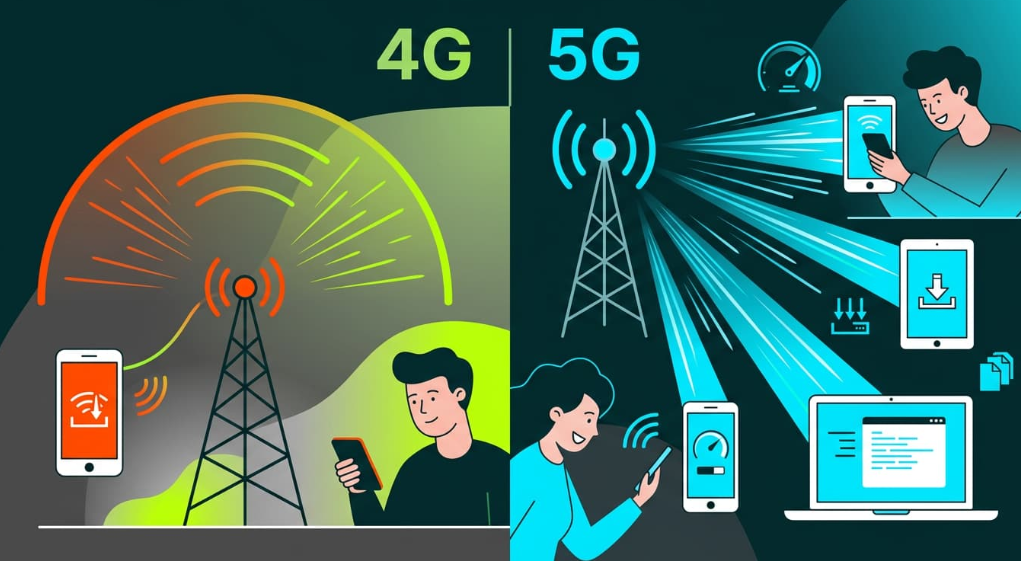
5G redefines connectivity beyond speed, embracing distributed intelligence, edge processing, and flexible architectures. It offers ultra-low latency, higher reliability, and dense device support through spectrum efficiency and network slicing. Edge computing shortens backhaul, while standalone and non-standalone deployments shape data paths and determinism for critical apps. The result is scalable, secure networks capable of real-time interaction and autonomous operations, but the implications for applications, business models, and security invite further examination.
How 5G Rewrites Connectivity Fundamentals
5G redefines connectivity fundamentals by moving beyond mere speed to rearchitect how devices access the network. The framework prioritizes distributed intelligence and local processing, enabling edge computing to reduce backhaul load and latency. Spectrum efficiency improves through advanced multiple access schemes and dynamic resource allocation, ensuring scalable bandwidth utilization. This shift empowers autonomous systems and flexible, resilient architectures without compromising spectrum discipline.
Latency, Capacity, and Reliability: What Changes for Apps
Latency, capacity, and reliability undergo targeted changes for applications in a 5G-enabled environment.
The focus is on reduced end-to-end latency, enabling near real-time interactivity, alongside improved reliability through diversified paths and network slicing.
Latency breakthroughs emerge from edge processing and faster signaling.
Capacity expansion supports dense, concurrent connections, while determinism in delivery underpins critical app performance in fragmented spectra.
Real-World Impacts: From Cars to Cities
The improvements in latency, capacity, and reliability described previously enable tangible outcomes across transportation, urban infrastructure, and public services.
Real world impacts emerge through city scale deployments, automotive use cases, and industrial automation, where low latency supports responsive traffic management, remote monitoring, and autonomous operations.
Public safety networks gain robustness, while data-driven services enhance resilience, efficiency, and citizen freedom in everyday environments.
See also; Future Innovations in Battery Storage
Guiding Your 5G Strategy: What Developers and Businesses Should Do
To guide effective 5G adoption, developers and businesses should map strategic goals to capabilities such as ultra-low latency, enhanced mobile broadband, and reliable connectivity across diverse environments.
This framing informs prioritization, governance, and ROI assessment.
Focused on distributed networks and edge ecosystems, efforts should emphasize interoperable architectures, security, and scalable deployment models, enabling rapid piloting, measurable outcomes, and sustainable, freedom-oriented innovation.
Frequently Asked Questions
How Does 5G Affect Battery Life in Devices and Networks?
5G may reduce battery drain in optimized use cases by enabling more efficient transmissions and dynamic spectrum sharing, though peak loads can increase consumption; overall, battery life depends on device hardware, network conditions, and implemented power-saving techniques, affecting network efficiency.
Will 5G Replace Fiber for Backhaul in Urban Areas?
5G backhaul will not fully replace fiber in urban areas; it complements it. In practice, Urban fiberways remain essential for capacity. 5G backhaul introduces flexibility, yet fiber provides lower latency, reliability, and predictable throughput for dense deployments.
How Secure Is 5G Compared to 4G Across Layers?
5G security is stronger overall but varies by layer; a robust security posture emerges from architectural protections and ongoing updates. In layer comparison, cryptography, integrity, and network slicing reduce risk, though device and edge vulnerabilities persist across layers.
What Are the Privacy Implications of Ubiquitous 5G Sensors?
The privacy implications of ubiquitous 5G sensors include expanded data collection and heightened surveillance potential, raising privacy concerns about continuous monitoring, asset tracking, and behavior inference; governance, consent mechanisms, and robust anonymization are essential to mitigate risks.
How Will 5G Policies Impact Global Roaming and Costs?
Policy implications suggest tighter regulation and pricing harmonization, shaping roaming economics through streamlined interconnections and standardized fees, while governments weigh spectrum and data localization. The analysis remains technical, concise, and crafted for audiences valuing freedom and efficiency.
Conclusion
5G redefines connectivity not merely by faster speeds, but by reshaping latency, reliability, and edge-enabled intelligence at scale. Its architectural shift—from centralized clouds to distributed processing, network slicing, and near-zero backhaul latency—turns real-time interaction into a practical certainty. For developers and businesses, this isn’t incremental improvement; it’s a tectonic leap that makes autonomous systems, ultra-responsive apps, and city-scale analytics possible. The result: networks that behave almost telepathically, delivering precision and determinism previously deemed impossible.
